
Getting your child excited about music lessons is one thing. Getting them excited about practicing is another.
If you've ever heard, “Do I have to practice today?” you’re definitely not alone.
One of the simplest ways to make music practice more enjoyable is to let children learn songs they already know and love.
Instead of spending every practice session working through exercises that feel disconnected from the music they enjoy, students can learn real songs while developing the same musical skills they need to become confident musicians.
Music educators have long recognized the value of making music learning engaging and developmentally appropriate for children. The National Association for Music Education emphasizes that children benefit from meaningful opportunities to participate in music and that positive relationships and experiences can make music learning more effective and enjoyable.
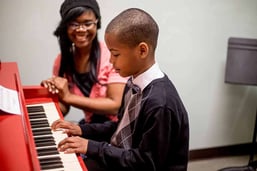
And many modern music programs use familiar songs as part of instruction because students are often more motivated when they can see themselves actually playing the music they enjoy.
So, what songs can your child learn?
🎵 1. “Happy” — Pharrell Williams
This upbeat song is instantly recognizable and gives students a chance to work on rhythm, repetition, and musical expression.
It can be adapted for different instruments and skill levels, making it a fun choice for beginners who want to play something recognizable fairly quickly.
Great for: Piano, guitar, voice
🎸 2. “Count on Me” — Bruno Mars
“Count on Me” is a great option for young musicians because of its memorable melody and approachable feel.
It can also be an opportunity to introduce students to chords, accompaniment patterns, rhythm, and singing while playing.
Great for: Piano, guitar, voice
🎹 3. “Let It Go” — Frozen
If your child loves Disney, this one can be a huge motivator.
Learning a song connected to a favorite movie or character can make a lesson feel less like “practice” and more like something the student actually wants to accomplish.
Great for: Piano, voice
🎤 4. “A Million Dreams” — The Greatest Showman
This song gives young singers an opportunity to work on melody, dynamics, phrasing, and expression.
It can also be a wonderful introduction to the idea that singing isn't just about hitting the right notes—it's about communicating something.
Great for: Voice, piano
🎸 5. “Riptide” — Vance Joy
For beginning guitar players, songs built around recognizable chord patterns can be particularly motivating.
“Riptide” has a distinctive sound that can help a young guitarist experience the excitement of accompanying themselves on a real song.
Great for: Guitar, ukulele
🎹 6. “Someone You Loved” — Lewis Capaldi
This song can be a good choice for students who enjoy current pop music.
Depending on the student's level, a teacher can simplify the arrangement and gradually introduce more of the original musical ideas as the student develops.
Great for: Piano, guitar, voice
🎤 7. “Shake It Off” — Taylor Swift
Sometimes the best song for a child is simply one that makes them smile.
“Shake It Off” gives students an opportunity to explore rhythm, movement, performance, and confidence.
For younger students especially, songs that encourage them to perform rather than simply play notes can make music lessons more exciting.
Great for: Voice, piano
🥁 8. “We Will Rock You” — Queen
This is a fantastic example of how simple musical ideas can be incredibly fun.
The instantly recognizable rhythm makes it especially appealing for beginning percussionists and can introduce students to pulse, rhythm, dynamics, and ensemble playing.
Great for: Drums, piano, guitar
🎸 9. “Perfect” — Ed Sheeran
A slower song like “Perfect” can help students work on control, steady tempo, phrasing, and musical expression.
It's also a good reminder that learning music isn't always about playing as fast or as loudly as possible.
Sometimes the goal is learning how to make a song sound beautiful.
Great for: Guitar, piano, voice
🎶 10. Their Favorite Song
Here's the most important one.
Your child's favorite song might be the best song for them to learn.
It doesn't have to be on a predetermined list.
Maybe they love a Disney song. Maybe it's a Taylor Swift song. Maybe it's a video-game soundtrack. Maybe it's a song they heard on the radio—or one their parent plays at home.
The important thing is that the song gives them a reason to say:
“I want to learn that.”
Why Favorite Songs Can Make Music Practice More Enjoyable
Children don't all learn music in exactly the same way.
Some students love scales and exercises. Others would rather spend 30 minutes learning the chorus of their favorite song.
That doesn't mean one child is more serious about music than the other.
The key is finding ways to connect foundational skills with music that feels meaningful to the student.
Research and professional music-education resources emphasize the importance of helping students develop goals, self-monitor their progress, and build productive practice habits.
That's why a good music lesson isn't simply:
“Here's your assignment. Go practice.”
It's more like:
“Here's a musical goal you care about. Let's figure out how to get you there.”
The Secret to Better Practice?
Don't make practice feel like punishment.
Instead, try giving your child some ownership.
Setup a time before dinner or screen time where they practice for 15 minutes a day. Consistency is the key. Very few children inherently want to practice anything, they need training and discipline which comes from watching themselves practice and finding success.
Ask:
“What song would you LOVE to learn?”
Then bring that song to their music teacher.
A teacher can often take a student's favorite song and adjust it to their current ability level. As the student improves, the arrangement can become more challenging.
That creates something incredibly powerful:
The student can hear themselves getting better.
And when children can play music they recognize and enjoy, practicing can start to feel less like another chore and more like making music.
At Creative Soul Music School, We Want Kids to LOVE Making Music
At Creative Soul, our goal isn't simply to teach children how to read notes or play an instrument.
We want students to develop a genuine connection with music.
That means helping them build foundational skills while also giving them opportunities to play music they actually enjoy.
Because when a child says,
“Can I play that song again?”
that's a pretty good sign we're doing something right. 🎵
Ready to Find Your Child's Song?
Whether your child is interested in piano, guitar, voice, drums, or another instrument, the right song can be a great place to start.
Talk with a Creative Soul teacher about your child's interests and musical goals, and we'll help find music that meets them where they are—and gives them something exciting to work toward.
